Can you see? Saving our world, it’s up to you and me!

Students from Greece, Spain and Italy collaborated in the eTwinning project “Are you ready for… merry go round with a red vest?” during the school year 2021-2022. 

Inspired by the book Made on Earth of Wolfgang Korn, the students discovered the meaning of globalization and of circular economy. They realized that they can be part of the change that will better our world and make us all live together in peace.

Here you can find the activities carried out by students in order to identify actions that can promote the protection of our environment. They studied the habits of children in different parts of Europe through Statistics and they created posters to encourage good behaviors in schools, to support sustainable development.

Partners’ schools

  • Roberta Colombo, I. C. Merate, Italy
  • Margarita Dakoronia, 32nd Primary School of Piraeus, Greece
  • Despina Armenaki, 3rd Primary school of Chios Greece, Chios, Greec,me
  • Anatoli Vrocharidou, 4th Primary school of  Menemeni, Thessaloniki, Greece
  • Athanasia Glezaki, 3rd Primary School of Zakynthos, Zakyntos, Greece
  • Chrysoula Georgakopoulou, 54th Primary School of Piraeus, Greece
  • Inmaculada Mollá Todolí, CEIP El Bracal – Muro de Alcoy, Spain
  • Maria Pau Vilaplana, CEIP El Bracal – Muro de Alcoy, Spain

The activity

Subjects

  • Statistics and Mathematics
  • Science and Technology
  • Social studies
  • Art
  • Native language and/or English as second language

MaiN GOALS

Science and Tecnology:

  • Understand and reproduce the life cycle of products
  • Recognize the connections between human behaviour and greenhouse effect and between human behaviour and pollution
  • Know what waste is with particular regard to plastic waste

Statistics and Mathematics:

Learn to conduct investigations using the statistical inquiry cycle:

  • posing and answering questions
  • gathering, sorting, and displaying data
  • reading data from tables and charts
  • communicating findings based on the data

Art:

Use creativity and imagination to represent own ideas, thoughts and feelings through Technology and Art

Social studies:

  • Develop awareness about the impact that behaviours can have on environment
  • Promote responsible production and consumption
  • Support and promote positive social and environmental relations in schools and cities
  • Strengthen participation in community life

21St century skills

  • Sense in entrepreneurship
  • Problem solving skills
  • Communication skills 
  • Ability to work in a team and collaboration
  • Creativity

Connection to STEM careers

Employability skills developed:

  • communication:  learn to listen and to speak to each other respecting roles, turns, ideas
  • problem solving: explore complex problems by building the understanding through research and by analysing the causes and effects
  • creativity: generate new ideas by combining different concepts
  • team building: work well with others by understanding and respecting different cultures, beliefs and backgrounds; contribute to group decision making, recognizing the value of others’ ideas and contributions
  • aiming high:  work with care and attention to details and use a positive approach to new challenges

Teaching resources

Materials: PC, smart board, paper, pencils, colored pencils, felt-tip pens, cardboard

Online tools and resources:

Age of students: 7 – 11 years old

Process

Preparation activities

At first we collected plastic and paper waste from one or more days before the start of the activities.

Afterwards we displayed it to students and asked them what would happen to all this stuff. 

At last, in a brainstorming, we asked ourselves if all this waste was good for the environment and what we could do to minimize its environmental impact.

Science activities

We introduced students to the concept of waste and pollution, greenhouse effect and life cycle of a product and we then reflected on how human behaviour can impact the environment.

We asked students to answer to questions like these ones: 

  • Are there some habits that can impact our environment?
  • In your opinion, do students have the same behaviour in all schools and in all countries?
  • Are there some actions that can help schools to become more environmentally-friendly?

statistics activities

We invited students:

  • to choose a habit that can impact the environment to investigate
  • to create questions for a survey to compare their behaviour with their European friends’ one.

We created the survey using google forms and shared it with our European mates, inviting them to answer.

Once the survey’s responses were acquired, we invited students to:

  • collect data, organize them in tables and create charts by using a tool or by hand,
  • analyze data and charts,
  • share their results with their European mates. 

We proposed  them to read the results of the other schools’ surveys.

For this task we worked with the whole class or in small groups, according to the students’ needs and possibilities.

Social studies activities

We invited students to think on how they could improve their habits to enhance a more sustainable development. Furthermore, they reflected on what they could do to share their new knowledge in their school and community.

We supported their attention and motivation using videos and songs about this topic.

Art activities

At the end we asked students to work in a team and to draw a poster with a motto to promote good habits connected with their surveys. 

Assessment

We evaluated both the products and the process of the students’ learning path. To do this we payed particular attention to the outcomes of brainstorming and discussions, to the products and to the posters.

To keep students engaged in their learning process and have a formative assessment we made questions at the beginning and at the end of each lesson. We asked students to write or speak  for a few minutes about the most meaningful thing they learnt and we collected their answers. 

As a final assessment we evaluated students’ products: charts and tables, the ability to read and to connect data with real life and the Art posters.

Final products

We collected all the surveys and results in this e-book.

We created a sustainability corner in our schools.

Have a look to our virtual Art exhibition that was created in order to involve the community.

You can also play this sustainability game: by solving all the quizzes, you will earn your environmental awareness certificate.

Conclusion

The cooperation between teachers  was one of the main points of the project and allowed us to go on with the activities, in spite of some problems connected with the CoronaVirus emergency. 

We used several online tools and applications to facilitate collaboration and communication between students and teachers. Besides, most of the activities were implemented in class so that students were able to work collaboratively, exchange and discuss.

Teachers adapted the activities and the teaching methods to the needs of their students, with regards to their age, country and interests.

Most of the activities were implemented in English as a second language. However, given the early age of some students, teacher’s mediation was essential in many activities.

After the project, students understood that STEM subjects help in understanding real life problems. During the process they learnt that they can be an active part of the change, because they can act for a more sustainable development. This fact made them feel very proud of their work.

It was also very interesting for them to observe the questions asked by their European mates, to give their answers and to observe similarities and differences in the various types of habits.

The ART OF GRAVITY

The Art of Gravity is a multidisciplinary project carried out by 3 teachers of 2 different countries: Spain and Greece.

The lesson plan arises as a result of  STEAM Scientix Modules, in order to be Scientix Ambassadors. We met in a special environment, sensitized to find a new way to approach science in the classroom, to provide students with enough tools to let them have in their minds the concern to research and to be possible future scientists.

This scenario contribute to show what gravity is and how to guide Primary School children to achieve this objective: using an experiential way, motivating them through gamification, and also using their bodies (music), their creativity (arts) their curiosity: IBSE, and computers (technology) in order to make them the concept interactive, attractive and more understandable. Cooperative Assessment is needed: peers participate in whole education process.

Our lesson plan is committed to experiential teaching. We believe the students are the protagonists of their own learning and to let them think is more important than memorizing mechanically.

The methodology, based on the intersection of Science and Art, in order to bring scientific thought closer to Primary School students, opens a door to interdisciplinarity, as in this case: the union of Music, Fine Arts and Science or, more precisely, the approach of concept of gravity, through music, sculpture and movement.

By observing, and starting from the most basic, the beat of our heart, we understood the meaning of the musical tempo and the questions arose, Inquiry Methodology, stimulating the curiosity to learn: at a slower tempo we move slowly, like being on the Moon.

So,

“Why do we move slowly on the moon? Can we explain what gravity is? Is there earth on gravity? And in space?”

IBSE: Inquire Basic System Education.Children wrote down the their questions about gravity and space:doing a mural or doing a padlet  attending to Covid 19 measures.

Through our body, music and movement we have experienced the effect of gravity, balance, strength-balance positions between couples, helping to overcome the tendency to fall, defying gravity.

The concern to know continued, “what is a black hole? Is there gravity?” We have created recycled instruments to imitate the magical sound of the cosmos and we have invented soundscapes, adding even musical apps, to imagine the feeling of being a space traveler.

After this introduction, children created an Arts and Crafts mobile to experiment where is the center of gravity.

IBSE: Inquire Basic System Education.Children wrote down the their questions about gravity and space:doing a mural or maybe suitable a padlet,  attending to Covid 19 measures.

And children programmed a game, using Scratch to simulate a Space travel, and where gravity is the protagonist not to crash against asteroids.

And we added Engineering Tasks: Create a Spacecraft using Lego WeDo.

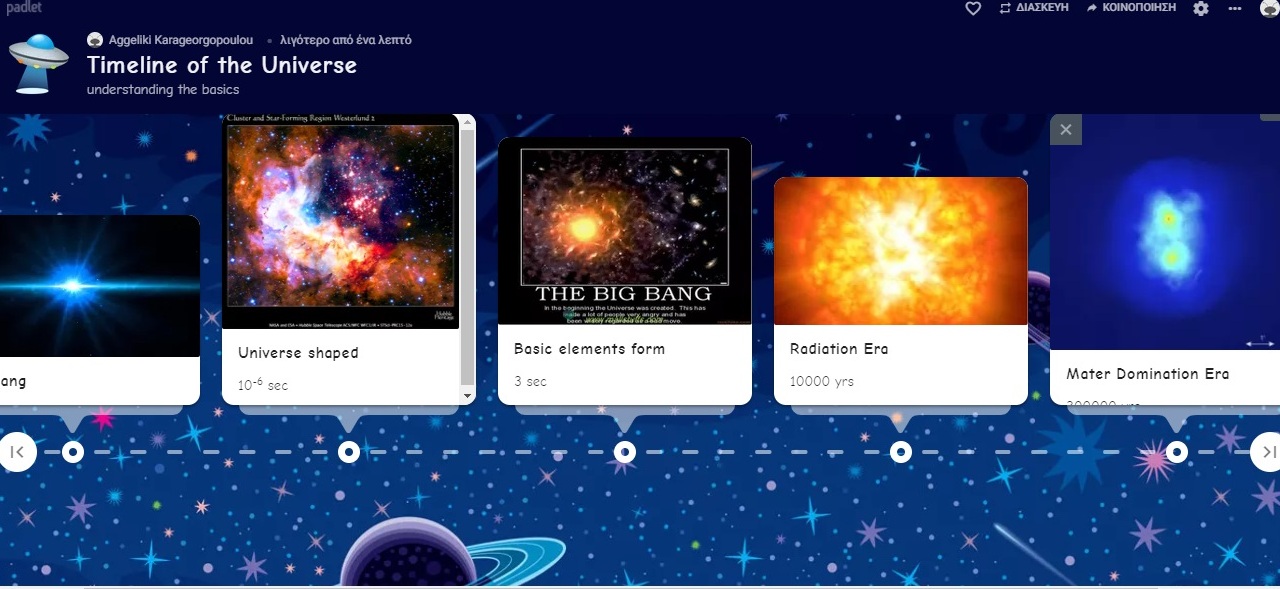
Pupils made a model of the universe, using simple materials. Then, they used paddlet to made the timeline.

To summarize all the project, children divided their work to focus in an important aspect about gravity and they worked using Google Drive Slides platform, in order to show to the other mates the work done in a presentation.

Finally, the project ended using several tools to do the assessment, and asking children to participate in an active evaluation done by themselves.

To conclude, we would like to introduce ourselves and also to explain our contribution in this common project:

Our STEAM team has been integrated by 3 peers,

Angeliki Theodosi. ICT Teacher at Ralleia Experimental Primary School in Piraeus, Greece. The purpose of the proposed activities is to introduce Science through Art, by creating mobiles to play and experiment with the center of gravity as well as by Programming a Game which the player has to defeat gravity using his/her voice (a fun way for children with hearing problems to experiment themselves on controlling their voice ). Also with their voice pupils can adapt the velocity of the robot.

Mireia Elias Gras. Music teacher at Can Fabra public school in Barcelona. The purpose to work science through music and body expression is to involve children to Gravity, beginning from the knowledge of their own body and their possibilities, experimenting gravity by themselves. Children inquire,  research working in teams, exposition of solved questions and peers assessment coevaluation, to involve our students to whole learning process.

Angeliki Karageorgopoulou, ICT teacher in 2nd and 4th Primary Schools of Lamia, Central Greece. With the proposed activities, students delve into the concepts of Physics related with the creation and expansion of the Universe, the reason why galaxies are moving away from each other, the reason why the planets revolve around the sun and explain the spacetime curvature.

We three wish you like our STEAM PROJECT: THE ART OF GRAVITY!

Zübeyde Hanım Kindergarten Learning with STEM

Gallery

In 2021, Denizli Zübeyde Hanım Kindergarten received the STEM School Label. This year, we participated in the 2022 STEM Discovery Campaign with the “Zübeyde Hanım Kindergarten Learning with STEM” event we organized throughout April in order to bring the STEM … Continue reading →

STEM Stands Together

This year’s theme of the STEM Discovery Campaign, “STEM for all”, is the starting point of this event. The purpose of the event was the development of students’ social and academic skills through a joint STEM workshop, attended by Turkish and refugee students.

Our target

16 students participated in the event which was held on April 22, 2022. Eight of the students were Turkish and eight of them were students who came to Turkey as refugees from Syria, Iraq, Afghanistan and Iran.

Our common language is STEM

STEM education has become very popular lately. In this event, we used STEM as the common language of students who do not know each other. Students came together in a STEM activity and realized a common goal. In the process, they also made new friendships. 16 students were divided into 8 groups. Each group consisted of one Turkish and one refugee student. At the very beginning of the event, an ice-breaking activity was held. There were fun moments as the students learned each other’s names.

The story of the event

After the icebreaker, information was given about the event. In the activity, it was aimed that the students learn about angles, which is a mathematics subject. The students did an internet research about the angles and shared their findings with the class. The teacher tried to embody the subject by giving examples of real-life aspects.

The BBC micro:bit kit was used in this event. Most of the students had not received coding training before. For this reason, block-based coding was preferred. BBC micro:bit coding was taught to students in the Microsoft Makecode.

Students were asked to develop a material for angles. With this material, students developed a mechanism to control angles using the BBC microbit. In this section, the students followed the instructions given to them. They demonstrated an excellent example of teamwork.

Students used the following guide for servo motor and micro:bit connection: https://www.instructables.com/Run-a-Mini-Servo-With-Microbit/

In the next step, students were asked to develop a material that went 10 degrees forward when the A button was pressed, and 10 degrees backwards when the B button was pressed.

In the last stage, students were asked to present their materials. The course teacher took notes and evaluated the students. The workshop was concluded by receiving student feedback with a Google Form.

End of a fun activity

The event ended with a certificate ceremony. The event, which was held for the theme of STEM for all, ended with the farewell of the students (for now, of course). Thanks to the activity, students both learned and made new friendships. The fusion of Turkish and refugee students was the most important achievement of this event.

What did the students express?

At the end of the activity, the feedback was received from the students with a form. The students stated that they were prejudiced against each other before, and that they could spend more time together after this activity. They stated that they understood the subject better with the STEM activity, that they found coding very entertaining and instructive, and that they expected such activities to continue in the future.

In this event, we used the unifying power of STEM and completed a fun activity. Thanks to our common language, STEM, students broke down the walls while learning. STEM for all…

This project was funded by We.

Check our activity video: https://youtu.be/N1YazlYeDxY

Our event took place last week, take a look how it went:

The water bridge of tolerance

Nicoleta Livia Barbu

Key words: STEM, Tolerance, Water, Pollution, Awareness

Activity duration: 04-08.04.2022 (5 days)

Summary

The topic of marine animals and water pollution provides students with knowledge and real-life problems for them to experience, discover, explore. It also puts an accent on tolerance and its close values towards a sustainable, clean environment.

Topics: Water animals, Water pollution, Tolerance & values, Protection of natural environment

Aim:

By the end of this Learning Scenario, students will be able to identify forms of marine animals, to explain water pollution. Students will be able to link tolerance and values with protection of surrounding environment.

Teaching materials necessary:

  • Communication & Literacy: “The bridge – a story about tolerance”, different images
  • Science: microscope, glass recipients, magnifying glasses, salt, pepper, oil, paint, seashells, sea star
  • Technology: laptop with microphone and camera, papers and pencils, printed Quiver sheets, tablet or smartphone
  • Social Studies: “The hedgehog story”, A2 white cardboard, paint of different colors, little cardboard stars
  • Art: “The Little Mermaid” fairy tale, printed coloring sheets with different types of fish, colored pencils, scissors, glue, blue A4 cardboard
  • Free Play: selected images, pictures, books, encyclopedias, coloured pencils, colouring sheets,microscope, recipients in different shapes and colours, magnifying glasses, seashells, sea star, pencils, papers, colouring books, different construction sets, electric fishing game, magnetic fishing game.

I used the following resources:

When eTwinning & Scientix are friends…

The activities designed and implemented in this Learning Scenario are part of the eTwinning Project S.E.C.H. Sustainable Education and Cultural Heritage.

The most important step in the implementation of the Learning Scenario was to design the activities. So I started from a set of driving questions that triggers curiosity and a sense of purpose to the students while at the same time enhance their focus in the process of learning.

I encouraged my students to take decisions, think unconventional solutions and collaborate. Instead of being afraid of making mistakes, they were motivated to take the lead, share and exchange knowledge and ideas with their peers while I was a supporter and a facilitator.

I designed and planned the Learning Scenario and together with my students. We created a schedule, selected activities, explained the working process and decided the final output and the evaluation criteria.

The activities provided within the Learning Scenario contribute to the development of students’ mind and allow students to be involved and make a difference.

The Learning Scenario’s topics allowed students to develop the 21st century skills. All students benefit from the knowledge and learning in a more attractive way.

When learning never stops…

A variety of pedagogical methods were used to engage students into learning. Observation, conversation, brainstorming were great ways to discover and explore the new topics. The activities were student-centered, were interesting and fun. Learning became more attractive, students developed imagination, creativity and raised their self-confidence. The activities offered learning support by allowing students to become scientists, researchers, artists.

The visit to the Science Museum was a great way to actually see for real what we discussed inside the classroom. They were really curious and asked the museum curator a lot of questions. Museum curator was astonished by the multitude of information the students acquired so far.

Link to Learning Scenario: https://drive.google.com/file/d/1b0cwXFT3hwmIjVwLYErfk-4mBtc7D6oy/view?usp=sharing

Link to photo presentation of the implemented activities:

https://www.canva.com/design/DAE_R8HLxuo/IQMgrEN_oQlagBwX7rFDUw/view?utm_content=DAE_R8HLxuo&utm_campaign=designshare&utm_medium=link2&utm_source=sharebutton