Pollution is a kind of damage to the environment. Substances or wastes cause it. Some pollution breaks down quickly. However, some might take thousands or millions of years to break down. Therefore, food waste is a global problem. It is threatening environmental, social and economic sustainability.
In this learning scenario, we are planning to find solutions to prevent environmental pollution. For instance, we can use homemade waste. In addition, we will have a useful product. Firstly, students will learn a way of preventing environmental pollution. It will be by recycling food waste at school or in their household. They will use a simple method. Secondly, they will be simulating the worm’s role in nature. Worms are used to recycle food into valuable soil. Thirdly, students will produce fertilizer for planting. They will help to clean the environment. Moreover, the pollution will decrease with the help of recycling. As a result, students will discuss other solutions for pollution. Also, they will prepare a final presentation of their findings. Some will prepare posters in Turkish or English.
Think sketch vector – The visual was provided by the Author – Attribution CC-BY
STEM teachers from nine schools in six different cities in Turkey we have come together. And 50 students. For Sustainable Development Goals. Our aim is to provide 21st century skills. We carried out this project together with 3 schools from İzmir, 2 schools from Ankara. With one school each from Manisa, Kütahya, Eskişehir and Kocaeli cities. So this was a country project.
In the I Design with STEM project, we improved our problem solving skills. Our students discovered STEM fields and produced projects.They took responsibility and learned to express their feelings. They found solutions to problems with their peers from different cities. And learned to use technology wisely. Because they really needed it.
Activities and Projects
Our students learned the web 2.0 tools. Made various collaborative activities while living in a meeting and social environment. Because we wanted students to make a difference with STEM.
In addition, we discussed different topics in STEM activities every month in our project. Topics included: Recycling, Energy Conversion and Design, Technologies for the Disabled.
We also formed mixed teams at each event. Teachers and students changed teams in every respect. Students designed original products for real life problems and to make life easier. As a result of this, we produced 15 different projects in 6 months with teams.
Students STEM projects that make a difference
Rainwater recycle system: We collected rainwater from the roofs of the houses. We also recycled the waste water that went to the sewer.
Shelf organizer: We produced more useful furniture with recycled materials.
Nature friendly and economical building: We designed an nature friendly house that generates electricity from waste.
Waste battery box: We recycled the batteries so that they do not harm the nature.
Garbage separation system: We designed a system that collects and separates garbage automatically.
Geological village: We have developed an environmentally friendly village system that produces everything on its own.
Solar lighting system: We provided lighting with solar channels for buildings that need daytime lighting.
Technological animal shelter: We built an unmanned and intelligent animal shelter.
Solar home heating system: We brought sunlight to all four parts of the house and provided heating.
Smart prosthetic arm: We said it should be more than just one hand.
Smart wheelchair: This wheelchair simply cannot fly. For now.
Playground for disabled children: We designed special parks and toys for children with disabilities.
Special bus for the disabled: We built a barrier-free bus.
Smart home system: An nature friendly and safe smart home. Who would not want that.
We learned science, tech, mathematics and engineering disciplines with real life problems. We exhibited student work examples on the website we prepared.
The pictures belong to the Author – Attribution CC-BY
Scientix Support for the Project
To support our project, Scientix Turkey Coordinator Dr. Tunç Erdal AKDUR and Scientix Ambassador Baki KARAKOÇ presented. From every city in Turkey for our presentation we had more than 300 participants. In this meeting, the work of teachers and students was introduced. We explained the project preparation techniques and STEM School Label application. Also our project was featured in the national and international press.
Partner and Article Author: Baki KARAKOÇ (Scientix Ambassador)
This learning scenario emerged from an extensively impressive Nature-Based Solutions MOOC. The learning outcomes of the MOOC supported with an eTwinning Project namely Happy Land. Students have a chance to gather eco-conscious skills.
In fact, recycling is an important issue for sustainable ecosystems and to leave a better planet for future generations. For a sustainable society, recycling is a key competence to be learned. To achieve this, this learning scenario provides students with inquiry and a project-based learning environment in an interdisciplinary approach.
To achieve the goals of the objectives, Project-Based Learning (PBL), Inquiry-Based Science Education (IBSE) learning approaches and STEAM will be used.
We always say health comes first. Because without health, material wealth and nothing in life matter. As long as a person is healthy, he can develop. However, there are some factors that affect this development. The most important are needs and problems.
One of the primary goals in education is to raise individuals who can solve problems. It can be helpful to both themselves and others. Approaches such as IBSE, PBL, Design Thinking, STEM are applied to gain problem-solving skills. The most basic factor that ensures success is to make students good observers and make them aware of the problems.
Creating problem awareness
We use cyclical steps such as the Design process and Innovation process in all activities in the Technology and Design course. But the first step of these processes is always the Problem. However, a student who understands and defines the problem well can be successful in the continuation of the process. To achieve this, we dedicate 1-2 weeks of Design Thinking to the problem phase only.
This is the first question we use to introduce our Project.
At Escola Mestre Gibert, teachers believe all knowledge is connected. Thus, 4th level Primary School teachers have decide to plan an interdisciplinary Renewable Energy Project, where all subjects can be included. The name of the project will be “Human Activity is Energy”.
Critical thinking, cooperation, creativity and communication are our skills
To engage the children, we use inquire based-learning. We build the project while creating challenges that they will solve and answer along with adding achievements.
As a result, teachers create and launch a collaborative project, where students’ experiments prove that energy is everywhere. Consequently, all subjects can contribute to build meaningful and comprehensive energy learning.
In subjects such as Science, Technology, English Language and First Language, students build knowledge about energy and its uses. TheEnglish Language is the vehicular language to transmit the result of the learning process.
Moreover, a father of a student whose task is related to Clean Energies, will come to deliver a speech as an expert.
The challenge of students’ teamwork is the study of Renewable and Sustainable Energy, doing an internet research. They use the DRIVE platform to organize their work and organize an exposition in class. In this activity, the peers assessment will be very important.
Project evaluation
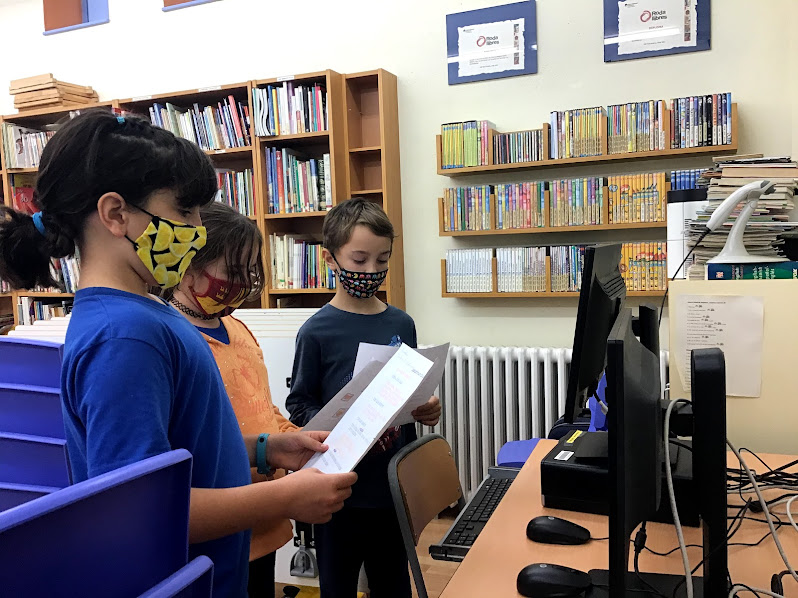
As we mentioned before, co-evaluation among peers is very important in order to obtain a good assessment. Students have to participate actively in all the learning process and until the end. Children use rubrics to pay attention to peers’ exposition and to express their opinions.
The photos were taken and kindly provided by the author – Attribution CC-BY
Finally, the children will perform a choreography to conclude the project, playing with multi-colour satin ribbons. For the soundtrack, previously we will record children’s voices singing a song called “Energize”, especially composed for the final show.
The photos were taken and kindly provided by the author – Attribution CC-BY
The song’s message is about Energy Resources and Earth Planet Health. Children enjoy singing the song and are engaging with its message:
On the last day of the project, students and teachers will gather together for a manifestation with banners, all spread around the playground, shouting messages such as: “save the Planet”, “we must use sustainable energy”, “SOS, planet Earth needs us!!”.